
Nyungwe Forest National Park
Nyungwe Forest National Park is located in the southwestern corner of Rwanda, where mist clings to the hills and the calls of chimpanzee’s echo through the trees, lies one of Africa’s most extraordinary wilderness areas. Nyungwe Forest National Park protects a vast montane rainforest that has stood for millennia, surviving ice ages and remaining one of the oldest continuous forests on the continent. The park covers an area of than 1,000 square kilometers, this UNESCO World Heritage Site offers travelers an experience completely different from the savannah safaris of East Africa.
Nyungwe is not a place for lions or elephants. It is something rarer. Here, thirteen primate species swing through the canopy, more than 300 bird species fill the air with song, and trails wind past waterfalls, swamps, and ridgelines with views across the hills of Rwanda. For travelers who have already tracked mountain gorillas in Volcanoes National Park or are looking for a deeper immersion into the country’s natural heritage, Nyungwe delivers an unforgettable chapter in any Rwandan safari.
Attractions in Nyungwe Forest National Park.
Nyungwe Rainforest.
The forest is the main safari attraction. Nyungwe protects one of the oldest montane rainforests in Africa, a green cathedral of towering mahogany trees, giant lobelias, and over 1,000 plant species, including more than 120 varieties of orchid. Walking through this forest feels like stepping back in time. The air is cool and damp. The forest sits at an altitude of 1,600 to 2,950 meters, which keeps temperatures pleasant and creates the misty mornings that make Nyungwe so atmospheric.
Chimpanzees.
Two habituated chimpanzee communities live within Nyungwe, making it one of the best places in East Africa to track our closest relatives. The main community resides within Nyungwe Forest itself, while a smaller group lives in the Cyamudongo Forest fragment, about an hour away by road. These chimpanzees are wild and active, moving through the trees, feeding on fruits, and calling to each other across the valleys. A successful trek offers one unforgettable hour in their presence.
Thirteen Primate Species.
Beyond chimpanzees, Nyungwe is home to an astonishing diversity of primates. Troops of Angolan colobus monkeys, with their flowing black and white coats, move through the canopy in groups of up to several hundred. L’Hoest’s monkeys, with their distinctive white beards, are often spotted along the forest edges. Grey-cheeked mangabeys, owl-faced monkeys, silver monkeys, and vervet monkeys also call this forest home. For primate lovers, Nyungwe is a paradise.
Bird Species.
Birdwatchers rank Nyungwe among East Africa’s finest forest birding safari destinations. The park records more than 300 bird species, including 27 Albertine Rift endemics found nowhere else on earth. The Ruwenzori turaco flashes green, blue, and purple as it moves through the canopy. The handsome francolin skulks in the undergrowth. The red-throated alethe and the Kungwe apalis are prized sightings for serious birders.
Tea Plantations.
The edges of Nyungwe are covered in emerald tea plantations that roll away from the forest line in terraced waves. These plantations, particularly around Gisakura, offer stunning views and opportunities to learn about Rwanda’s tea industry. Visitors can tour the fields, watch workers plucking the leaves, and sample freshly brewed tea while looking out over the green hills.
Activities to do in Nyungwe Forest National Park.
Chimpanzee Trekking.
The headline experience in Nyungwe is chimpanzee trekking safari. The day begins early, often with a briefing at the park headquarters before dawn. Chimpanzees are most active in the cool morning hours, and starting early gives the best chance of finding them quickly. Groups are limited to eight trekkers per troop, and trained ranger guides lead the search.
The trek can last anywhere from thirty minutes to four hours, depending on where the chimps spent the night and how far they have moved while feeding. There is a lot of mud and the landscape is hilly, hence the need for strong hiking shoes. After finding the chimpanzees, there will be one hour set aside to observe them. One may have the chance to see them feeding, grooming, or crashing around the trees.
Canopy Walk Experience.
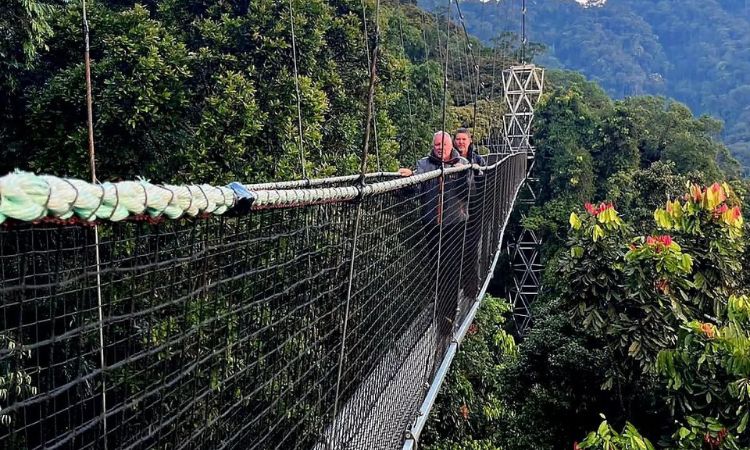
Nyungwe canopy walk is one of the most photographed safari experiences in Rwanda for good reason. A suspension bridge hangs 60 to 70 meters above the forest floor, allowing visitors to walk at canopy level among the treetops. The actual length of the boardwalk trail is around 160 meters, segmented into various sections linked by observation decks.
Getting to the canopy walk entails hiking through the rainforest via a trail that starts from the Uwinka Visitors’ Center, which takes up to two hours. The trail ends at the canopy walk. On a sunny day, one can see all the way to the ridges of the forest. It will be possible to observe tree ferns, giant mahogany trees, and even some colobus monkeys or blue monkeys.
Hiking and Waterfall Trails.
Nyungwe connects itself with over 130 kilometers of clearly marked hiking trails, which can vary from quick hikes up to full days of trekking. One of the best hikes is known as the Isumo Waterfall Trail, where you hike through forests with many ferns to see a strong waterfall hidden amidst the forest. This hike normally takes about three to four hours.
Igishigishigi Trail is another option that will not require you to climb, offering views at canopy level. Another easy trail is called the Karambaba Trail.
The Mount Bigugu Trail is for experienced hikers looking for something more adventurous; Mount Bigugu Trail is one of the highest places to be found in the park, giving beautiful views of both Rwanda and Burundi.
Colobus Monkey Tracking.
If you do not want the long and exhausting journey through the jungle to track chimps, then the other choice is the colobus monkey tracking. The Angolan colobus monkeys usually travel in big groups with their white and black fur moving as they swing on the tree branches.
Birdwatching.
Specialized bird-watching walks are also provided to the tourists interested in observing maximum species of birds. The guided walks take place near forest fringes, swamps, and ridge tops where birds are mostly seen. Whether a tourist is a bird watcher or not, they will be able to see the turacos, sunbirds, and robins that thrive in the park. The best time to observe these birds is during the mornings.
Visits to Communities and Tea Plantations.
Tourism around the Nyungwe region provides tourists with opportunities to interact with the local communities. Visits to tea estates may be organized where you can see the picking and processing of leaves. Tours may also be accompanied by sampling of traditional banana beer, dances, or visits to honey-making projects. These activities direct tourist revenues to local communities and help build knowledge about the surrounding areas.
Best Time to Visit Nyungwe Forest National Park.
Nyungwe National Park may be explored any time of the year; however, different seasons present distinct circumstances. With its elevation, Nyungwe has a cool environment with average daily temperatures ranging between 25°C and 27°C (77°F to 81°F) while the lowest average temperatures at night fall between 13°C and 16°C (56°F to 61°F).
The most ideal seasons for trekking in the park are during the dry seasons of June through September and December to February, where little rainfall is experienced, and vegetation is minimal. June, July, and August are the high seasons with ideal climatic conditions and the maximum number of tourists. Another good time is during December to February with the same climatic conditions.
The rainy seasons between March and May and October to November come with high rainfall and muddy hiking trails. There are benefits to visiting at this time too. During the wetter periods, fruiting trees are more abundant, so chimpanzees may stay in smaller areas and can sometimes be easier to find. The forest looks especially lush and green, and birding is often excellent. Crowds are smaller, and some lodges offer discounted rates. Travelers willing to accept muddier conditions can still have a rewarding experience. September is a transitional month that often sees minimal rainfall despite technically being part of the wet season. Many travelers consider it a high-season month for this reason.
Where to Stay Near Nyungwe Forest National Park
Luxury Accommodation; For travelers seeking the pinnacle of comfort, One&Only Nyungwe House is the best luxury accommodation in the area. Set on a working tea plantation overlooking the forest, this five-star lodge offers 22 luxury rooms and suites housed in wooden villas. Each room has an open fireplace, private veranda, and traditional Rwandan art. The lodge has an outdoor heated swimming pool, fitness center, spa, and fine dining restaurant. The lodge offers activities like guided chimpanzee trekking, canopy walks, birdwatching, and cultural experiences. Rates typically exceed $1,000 per person per night.
Mid-Range Accommodation; Mid-range travelers have several excellent options. Nyungwe Top View Hill Hotel offers comfortable rooms with forest views, reasonably priced for the quality. The Emeraude Kivu Resort that is located in the vicinity of the park provides quality services and convenient access to activities.
Budget Accommodation; The park has various guest houses providing comfortable accommodation at prices ranging between 40 to 80 USD per day. Another option of accommodation is camping in sites around the park headquarters, where facilities are limited. Booking in advance is strongly recommended during the peak dry seasons.
Accommodation Tips.
Most lodges and guesthouses are located outside the park boundaries, requiring a short drive to the Uwinka Visitor Centre where activities begin. Gisakura and around the park headquarters will save you travel time in the morning. If you are on an arranged tour, then your tour operator will take care of your accommodation arrangements.
How to get to Nyungwe Forest National Park.
By Road.
The best way of reaching Nyungwe Forest National Park is traveling by road from Kigali. The distance between Kigali and the forest park is about 220-230km. The road journey will take five to six hours. This journey includes traveling through tarmac roads, hilly areas, small towns, and tea plantations.
People mostly drive in their own 4×4 vehicle. This will give them an opportunity for taking photographs, rest stops, and visiting places like the Ethnographic Museum of Butare and the Royal Palace Museum of Nyanza.
The other option that will save you money is the bus route that runs from Nyabugogo Park in Kigali to Rusizi. The problem with this is that it will take a bit longer, around seven to eight hours.
By Air
Where time is of the essence or travelers require added comfort, air travel offers the faster mode. Rwanda Air provides domestic flights from Kigali International Airport to Kamembe Airport, which is around 45 minutes to an hour away from the national park. There are eight to nine flights per week.
Another fast option to visit Akagera National Park would be by chartering a helicopter flight service provided by companies like Akagera Aviation that takes around 45 minutes. These helicopters are capable of landing right at your chosen lodge/hotel premises.
However, most visitors choose to take the trip from the city on the road up to Nyungwe, as well as some other safaris in areas like Lake Kivu or Volcanoes National Park.