
Chimpanzee Trekking in Kibale National Park
Chimpanzee Trekking in Kibale National Park: On an African safari there are places in Uganda that quietly exceed every expectation the traveler brings to them, and Kibale National Park is perhaps the most consistent and most compelling example of that quality in the country’s entire national park network.
The park is located in western Uganda in the Kabarole District, approximately 26 kilometers south of Fort Portal town. Kibale National Park covers 795 square kilometers of moist evergreen forest, grassland, and wetland at altitudes ranging from 1,100 to 1,600 meters above sea level.
It is home to the highest density and diversity of primates of any forest in Africa, the finest chimpanzee trekking experience available anywhere on the continent, and a birdlife of extraordinary richness that makes it simultaneously one of Uganda’s most important ornithological destinations. Here is everything worth knowing about chimpanzee trekking in Kibale.
Kibale National Park.
Kibale National Park’s designation as the primate capital of Africa is not marketing hyperbole; it is a scientific assessment grounded in the park’s extraordinary concentration of primate species within a relatively compact forest area. The park supports 13 primate species in total, including chimpanzees, red colobus monkeys, black-and-white colobus monkeys, grey-cheeked mangabeys, red-tailed monkeys, L’Hoest’s monkeys, olive baboons, blue monkeys, and the nocturnal potto and bush baby species that night walks occasionally reveal. This concentration of primate diversity within a single accessible forest makes Kibale the most productively multi-species primate destination in East Africa and a genuinely unmissable component of any Uganda safari itinerary.
Chimpanzee Trekking at Kanyanchu.
Chimpanzee trekking in Kibale National Park departs from the Kanyanchu visitor center, the park’s primary trekking departure point, where all participants attend a mandatory pre-trek briefing conducted by Uganda Wildlife Authority rangers before entering the forest. The briefing covers behavioral protocols, safety procedures relevant to tracking a habituated but genuinely wild chimpanzee community, and an introduction to the ranger guide who will lead the group into the forest.
Trekking operates in two daily sessions. The morning session departs at 8:00 AM and is widely regarded as the most productive tracking window, with chimpanzees at their most active in the early hours, moving through the canopy with an energy and purposefulness that generates the most dynamic and visually compelling encounters. The afternoon session departs at 2:00 PM and offers a different quality of observation, with the community typically more settled and concentrated in specific forest areas as the day progresses toward the evening nest-building period.
The tracking group follows the ranger guide along trails that may be well-defined or may involve cutting through vegetation depending on the chimpanzees’ position on any given day. Trek duration varies from under thirty minutes to two hours or more, and this unpredictability, the knowledge that the encounter cannot be scheduled or engineered but must be earned through patient, attentive movement through the forest, is one of the most honest and rewarding aspects of the Kibale experience.
The One-Hour Encounter.
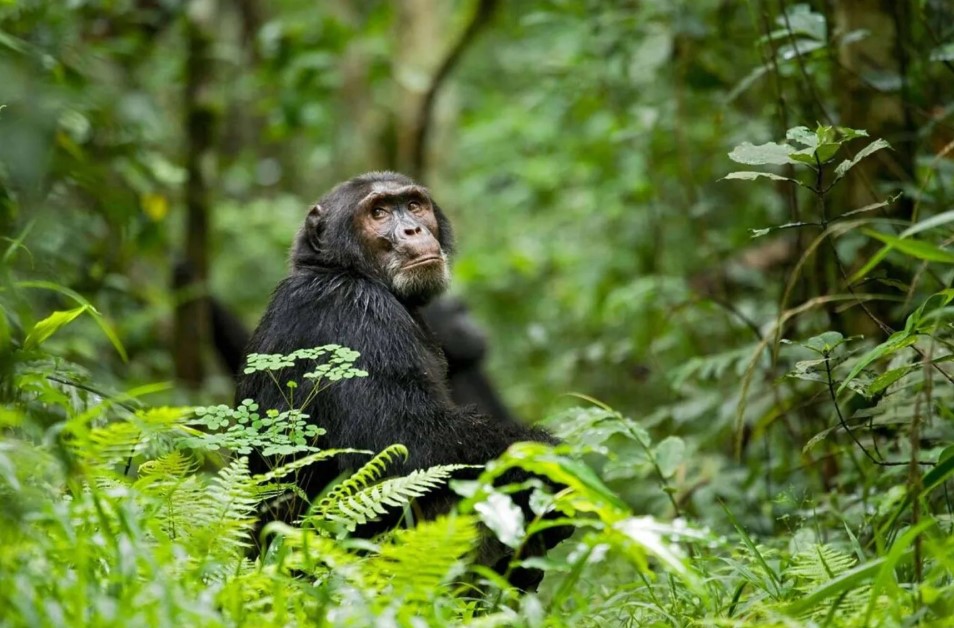
When the tracking group locates the habituated community, the one-hour encounter begins, and it operates on a register entirely different from a mountain gorilla trek. Where gorilla trekking is defined by stillness and gravity, chimpanzee tracking safaris in Kibale are defined by energy, noise, and the exhilarating unpredictability of an intelligence very similar to our own operating at full, uninhibited speed in its natural environment.
A feeding group in the canopy above the tracking party, the calls, the branch movement, and the occasional shower of half-eaten fruit descending to the forest floor is a sensory experience of remarkable intensity. Grooming sessions between adult individuals, the boisterous play of juveniles, the spectacular aerial travel of adults moving through the canopy at speeds that seem to defy gravity, and the occasional eruption of the community into a full, deafening chorus of group pant-hooting that carries through the forest for several kilometers are all observable within the one-hour window, and each contributes to an experience whose cumulative impact significantly exceeds the sum of its individual moments.
Permit Cost and Booking.
Chimpanzee tracking permits in Kibale National Park are issued by the Uganda Wildlife Authority and must be booked in advance through the official UWA portal or a licensed Uganda tour operator. Foreign non-residents pay USD 250 per person, foreign residents pay USD 150, and East African Community citizens pay UGX 90,000. The permit covers the pre-trek briefing, ranger guide services throughout the tracking session, and the one-hour encounter itself but does not include accommodation, meals, or transport to Kanyanchu. Permits for peak season dates between June and September and December and February should be booked a minimum of three months in advance, with earlier booking strongly advisable for larger groups.
Chimpanzee Habituation Experience.
For visitors seeking a deeper engagement with Kibale’s chimpanzees, the Chimpanzee Habituation Experience offers a full-day tracking session that allows participants to accompany the research and ranger team from dawn to dusk, observing the complete daily cycle of chimpanzee behavior from morning nest departure through feeding, traveling, resting, social interaction, and evening nest-building. The habituation experience costs USD 300 per person for foreign non-residents and provides a quality of behavioral observation that the standard one-hour trek cannot approach, making it particularly rewarding for visitors with a genuine interest in primate behavior and conservation science.
What to Bring.
Pack neutral-colored long-sleeved shirts and full-length trousers, sturdy closed-toe shoes with ankle support, a lightweight waterproof rain jacket, insect repellent containing DEET, high-factor sunscreen, a wide-brimmed hat, a minimum of one and a half liters of water, and energy snacks for the trail. A camera with a telephoto lens is valuable for canopy sightings where chimpanzees may be at considerable height, and fully charged batteries with sufficient memory are essential for a full morning of active wildlife photography.
Beyond the Chimpanzees: Bigodi Wetland Sanctuary.
Bigodi Wetland Sanctuary is located five kilometers from Kanyanchu. The community-managed Bigodi Wetland Sanctuary adds a rewarding birdwatching dimension to any Kibale visit, with over 200 recorded species, including the great blue turaco and the sought-after papyrus gonolek, alongside eight primate species observable from its boardwalk trails. Combining a morning chimpanzee trek with an afternoon Bigodi Walk creates one of the most ecologically complete single-day wildlife experiences available in western Uganda.
How to get to Kibale National Park.
Kibale National Park is located approximately 350 kilometers from Kampala, a five to six-hour road journey via Fort Portal town on well-maintained tarmac roads. Charter flights between Entebbe and Kasese airstrip reduce the journey to approximately one hour. Most Ugandan safari operators include Kibale as part of a western Ugandan circuit combining the park with Queen Elizabeth National Park, Bwindi Impenetrable National Park, and Lake Mburo National Park.
Conclusion: Chimpanzee trekking safaris in Kibale National Park are the finest chimpanzee trekking experiences available anywhere in the world, delivered at a level of habituation quality and tracking reliability that no other destination can currently match. Book your permit early, arrive at Kanyanchu rested and curious, and allow Kibale’s forest and its chimpanzees to deliver one of the most exhilarating and memorable wildlife experiences of any East African safari.