
Top Visited National Parks in Uganda | A Complete Safari Guide.
Top Visited National Parks in Uganda; Uganda is a country that rewards every traveler who arrives with curiosity and patience. Nicknamed the Pearl of Africa by Winston Churchill a man who had seen a considerable portion of the world by the time he visited in 1907 Uganda carries that designation with quiet justification. Packed into a landlocked nation roughly the size of the United Kingdom is a concentration of biodiversity that few countries anywhere on earth can rival: more bird species than the entire North American continent, half the world’s remaining mountain gorilla population, the largest tropical lake in Africa, and a chain of national parks that together form one of the most compelling safari ecosystems in the world. Here are Uganda’s most visited national parks, and why each one deserves a place on any serious East African itinerary.
- Bwindi Impenetrable National Park.
No list of Uganda’s most visited national parks begins anywhere other than Bwindi national park. Located in the southwestern corner of the country along the border with the Democratic Republic of Congo, Bwindi Impenetrable National Park is Uganda’s most celebrated wilderness area and the undisputed centerpiece of the country’s wildlife tourism economy. The park covers 331 square kilometers of ancient montane forest that has remained largely undisturbed for over 25,000 years one of the oldest and most biologically diverse ecosystems on the African continent.
Bwindi is home to more than 500 individual mountain gorillas across more than 25 fully habituated gorilla families, making it the single most important gorilla conservation site on earth. Gorilla trekking in its four distinct sectors Buhoma, Ruhija, Nkuringo, and Rushaga attracts visitors from every corner of the globe, and the Gorilla Habituation Experience offered exclusively in the Rushaga sector, which permits four visitors to spend four hours with a semi-habituated family, is widely regarded as the most immersive wildlife encounter available anywhere in Africa. Beyond the gorillas, Bwindi hosts over 350 bird species, more than 120 mammal species, and a forest environment of extraordinary depth and atmospheric power. It is a UNESCO World Heritage Site, and it earns that designation completely.
- Queen Elizabeth National Park.
Queen Elizabeth National Park is Uganda’s most biodiverse savannah park and one of the most productive game viewing destinations in East Africa. Established in 1952 and named in honor of the British monarch who visited two years later, the park covers approximately 1,978 square kilometers of open savannah grassland, wetlands, crater lakes, and riverine forest along the floor of the Albertine Rift Valley in western Uganda.
The park is home to over 95 mammal species and more than 600 bird species one of the highest bird species counts of any protected area in the world. Its wildlife includes large elephant herds, enormous buffalo populations, hippos in extraordinary numbers along the Kazinga Channel, leopards, hyenas, and the Ishasha sector’s celebrated tree-climbing lions a population of lions that has developed the unusual habit of resting in the branches of giant fig trees, a behavior found in only one other location in Africa. A launch cruise along the Kazinga Channel, which connects Lake Edward and Lake George, is one of the finest wildlife boat experiences in East Africa, offering close encounters with hippos, crocodiles, and waterbirds from the water’s edge.
- Kibale National Park.
Kibale National Park in western Uganda holds a distinction that sets it apart from every other park in the country and, arguably, from most parks on the continent: it has the highest density and diversity of primates of any forest in Africa. The park covers 795 square kilometers of moist evergreen forest and grassland at altitudes ranging from 1,100 to 1,600 metres above sea level, and it is home to 13 primate species including chimpanzees, red colobus monkeys, black-and-white colobus, grey-cheeked mangabeys, and L’Hoest’s monkeys.
The main attraction for the majority of Kibale’s visitors is chimpanzee tracking an experience that comes closer than any other primate encounter, outside of gorilla trekking, to the quality of mutual recognition and emotional depth that defines Uganda’s primate safari offering. The Kibale chimpanzee community is one of the most extensively studied in the world, and the habituation process that makes tracking possible has produced a population of animals whose comfort with human presence allows for remarkably close and extended observation. Kibale also offers the Primate Walk, a guided walk through the forest that encompasses multiple primate species in a single outing, and the park’s birdwatching opportunities are exceptional, with over 370 species recorded.
- Murchison Falls National Park.
Murchison Falls National Park is Uganda’s largest protected area, covering approximately 3,840 square kilometers of savannah, riverine forest, and wetland along the northern bank of the Victoria Nile in northwestern Uganda. It takes its name from one of the most dramatic natural spectacles in Africa: the point where the entire volume of the Nile is forced through a seven-meter gap in the rock before plunging 43 metres into the gorge below, generating a roar and a spray cloud visible and audible from a considerable distance.
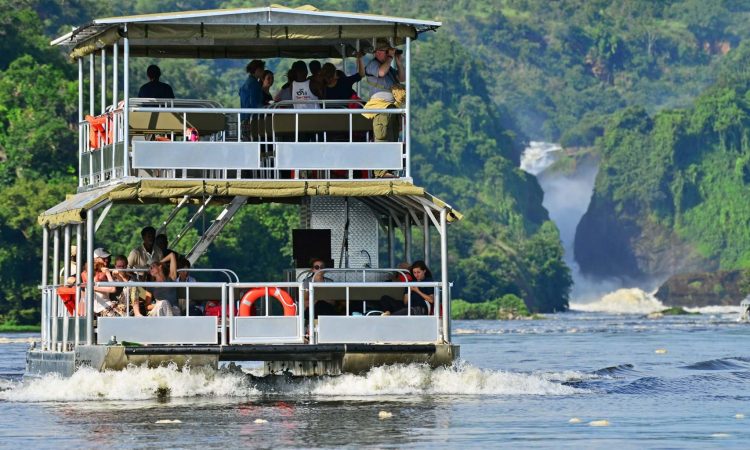
Beyond the falls, Murchison offers exceptional game viewing across an ecosystem that supports large populations of elephants, buffalo, Uganda Kob, giraffes, lions, leopards, and hyenas. A launch trip on the Nile to the base of the falls is a wildlife experience of remarkable density the banks are lined with hippos, Nile crocodiles of enormous size, and a spectacular array of waterbirds including the iconic shoebill stork, one of the most sought-after bird species in Africa. Murchison is also the best park in Uganda for seeing Rothschild’s giraffe one of the world’s most endangered giraffe subspecies in significant numbers.
- Kidepo Valley National Park.
Kidepo Valley National Park occupies a remote corner of northeastern Uganda along the borders with South Sudan and Kenya, and its relative inaccessibility has preserved an atmosphere of genuine wilderness that is increasingly rare in the more popular safari circuits of East Africa. The park covers 1,442 square kilometers of semi-arid savannah and rugged mountain terrain in the Karamoja region, and it supports a wildlife community that includes several species found nowhere else in Uganda.
Cheetahs, striped hyenas, caracals, bat-eared foxes, and aardwolves all occur in Kidepo animals that are entirely absent from Uganda’s other national parks. The park also hosts large herds of buffalo and elephant, Rothschild’s giraffes, lions, leopards, ostriches, and Burchell’s zebras. With over 475 bird species recorded, Kidepo is considered one of Uganda’s premier birding destinations. Narus Valley, the park’s primary game viewing area, offers a concentration of wildlife around permanent water sources during the dry season that rivals the best game viewing in East Africa. Kidepo rewards the traveler who is willing to make the effort to reach it with an experience of solitude and wildness that the more accessible parks in the country simply cannot replicate.
- Lake Mburo National Park.
Lake Mburo National Park is Uganda’s smallest savannah park and its most accessible from Kampala a four-hour drive along the Mbarara highway that makes it the ideal introduction to Ugandan wildlife for visitors with limited time or for those using it as a stopover on the journey between the capital and the gorilla trekking parks of the southwest. Covering approximately 260 square kilometers in the Kiruhura District of western Uganda, the park encompasses five lakes within its boundaries and a mosaic of acacia woodland, open grassland, and wetland that supports a distinctive wildlife community.
Lake Mburo is the only park in Uganda where Burchell’s zebras are found in significant numbers, and it holds the country’s only population of impala. The absence of lions and elephants a legacy of historical poaching pressure has created a uniquely permissive environment for walking safaris, horseback rides, and boat cruises that are unavailable in Uganda’s other parks. For the wildlife experience it delivers within its compact area, and for the logistical role it plays in connecting Kampala to the western parks, Lake Mburo punches considerably above its weight.
Conclusion; Uganda’s national parks collectively form one of the most diverse and rewarding safari ecosystems in Africa a network of wilderness areas that spans ancient rainforest and open savannah, mountain gorillas and tree-climbing lions, the world’s most powerful waterfall and some of the continent’s finest primate tracking. Whether you are visiting for the first time or returning for the tenth, Uganda’s parks offer a depth of experience that continues to surprise, move, and inspire in equal measure. The Pearl of Africa is a title that, once experienced, requires no further justification.