
Top Wildlife Encounters in Uganda.
Top Wildlife Encounters in Uganda; Uganda compresses an extraordinary range of wildlife safari experiences into a remarkably small geographic footprint, and few countries on earth offer this particular combination of primate forest depth and open savannah drama within a single, well-connected safari circuit.
The country’s geographical position at the convergence of four major African ecosystems the East African savannah, Congo basin forest, Albertine Rift montane zone, and the Sudan-Guinea savannah has produced a biodiversity that few comparably sized nations can rival. From the stillness of a mountain gorilla encounter to the chaotic energy of a golden monkey troop, here is a closer look at the wildlife experiences that define a Uganda safari.
Mountain Gorilla Trekking in Bwindi and Mgahinga National Parks.
Nothing in Uganda’s wildlife portfolio carries the weight of trekking mountain gorillas, and for good reason. Bwindi Impenetrable National Park alone hosts more than 25 fully habituated gorilla families across its four trekking sectors of Buhoma, Ruhija, Nkuringo, and Rushaga, making it the single most important mountain gorilla conservation site anywhere on earth.
Mgahinga Gorilla National Park, by contrast, offers a far more intimate single-family encounter with Nyakagezi group, whose territory drifts across the borders of Uganda, Rwanda, and the Democratic Republic of Congo according to its own ecological logic rather than any respect for national boundaries.
At USD 800 per permit for foreign non-residents, Uganda delivers the same one-hour encounter as Rwanda at nearly half the cost of its neighbor’s USD 1,500 fee, without any corresponding reduction in the quality or depth of the experience. The exclusive Gorilla Habituation Experience in Rushaga extends this further still, offering a maximum of four visitors four uninterrupted hours with a semi-habituated family an encounter of such behavioural richness and emotional intensity that many travelers who have done both describe it as the more profound of Uganda’s two gorilla trekking options. Standing within metres of a silverback whose composed, intelligent gaze meets your own is the kind of moment that recalibrates, in some permanent and largely indescribable way, a person’s understanding of their place in the natural world.
Chimpanzee Tracking in Kibale National Park.
Kibale National Park holds the highest density and diversity of primates of any forest in Africa, with thirteen species sharing its 795 square kilometers of moist evergreen forest in western Uganda. Its habituated chimpanzee community at the Kanyanchu visitor center delivers what is widely regarded as the finest chimpanzee trekking safari experience in the world, a product of decades of consistent, disciplined habituation work that has produced a population entirely at ease with close human observation.
The energy of a Kibale encounter is markedly different from the calm gravity of a gorilla trek. It is louder, faster, and governed by the spectacular unpredictability of an animal whose intelligence and social closeness produce a constant stream of behavioural events branch-shaking displays high in the canopy, the explosive group pant-hoot that can be heard echoing through the forest for kilometers, and the sudden, gravity-defying aerial travel of adults moving between trees at speeds that challenge the eye to follow. The adjacent Bigodi Wetland Sanctuary, managed by the local community, adds an exceptional birdwatching dimension to any Kibale visit and is well worth combining with the morning trek.
Tree-Climbing Lions in the Ishasha Sector.
Queen Elizabeth National Park’s Ishasha sector hosts one of only two known populations on earth where lions regularly rest in the branches of fig trees, a behavioural phenomenon found nowhere else in Uganda and in only one other location worldwide, Tanzania’s Lake Manyara National Park. The behavior is believed to have developed as a response to biting insects and the heat at ground level, though the precise reasons remain a subject of ongoing scientific interest.
A sighting of lions draped across the branches of a giant fig tree, three to six metres above the ground, with a combination of magnificence and apparent indifference to the gravity of their own positioning, is one of the more visually arresting wildlife encounters available anywhere on the continent. Ishasha’s relative remoteness within Queen Elizabeth National Park means the sector also offers a quieter, less trafficked game-viewing experience than the park’s more visited Kasenyi Plains.
Nile Boat Safari at Murchison Falls National Park.
The launch trip up the Victoria Nile to the base of Murchison Falls is one of Africa’s finest wildlife safari boat experiences, delivering close-range encounters with some of the continent’s largest hippo and crocodile concentrations along a river corridor of extraordinary biological density.
Elephants descending to the riverbank to drink and bathe are a regular feature of the journey, observed from the water at a proximity that no land-based game drive can replicate, and the birdlife along the banks African fish eagles, goliath herons, pied kingfishers, and the occasional shoebill in the papyrus margins rewards even visitors with no particular ornithological interest.
The destination itself, where the entire volume of the Nile is forced through a seven-meter gap in the rock before plunging 43 metres into the gorge below, is among the most dramatic natural spectacles on the continent, generating a roar and a spray cloud that the boat approaches closely enough to feel.
Shoebill Stork Watching at Mabamba Swamp.
Mabamba Swamp on the shores of Lake Victoria, a short drive from Entebbe, is the most reliable location in Africa to observe the shoebill stork, a prehistoric-looking bird whose extraordinary stillness and massive, shoe-shaped bill make it one of the continent’s most sought-after sightings for birdwatchers.
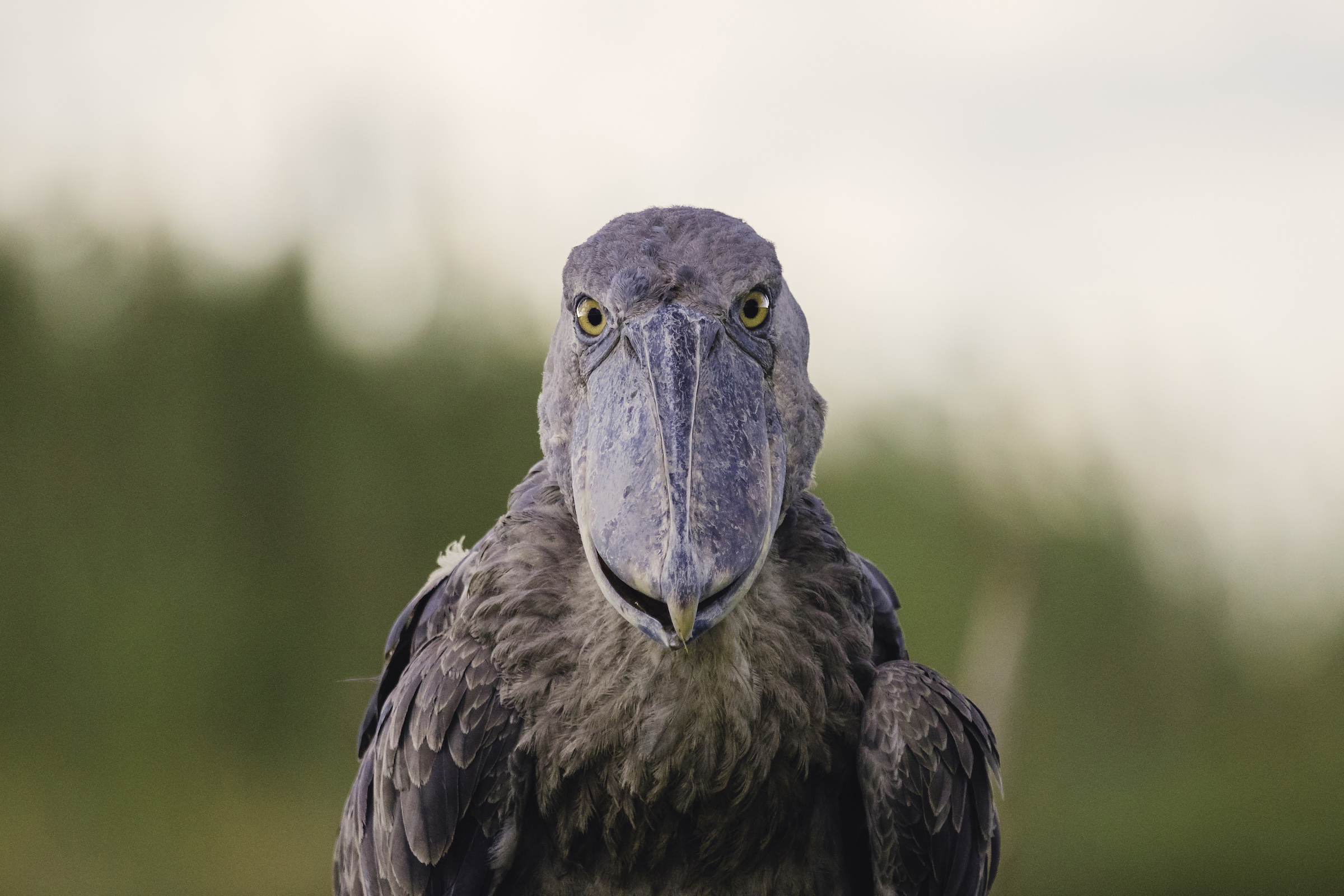
Accessible by a simple guided canoe trip through the papyrus channels, the swamp typically hosts between four and eight individual shoebills, and the species’ capacity to remain motionless for hours while hunting lungfish gives every sighting a quality of intense, concentrated observation rarely matched by more mobile wildlife.
Golden Monkey Trekking in Mgahinga.
Found in the wild in only Uganda and Rwanda, golden monkey trekking safari offers a primate encounter built on collective energy rather than individual gravity. Families of sixty to a hundred individuals move through the bamboo forest zones of the Virunga volcanoes in a spectacle of vivid golden-orange colour and near-constant motion, creating an emotional register entirely distinct from the calmer, more contemplative gorilla encounter that most visitors pursue alongside it in the same park.
White Rhino Tracking at Ziwa Sanctuary.
Following the species’ local extinction in Uganda by the early 1980s, Ziwa Rhino Sanctuary in Nakasongola District has rebuilt a population of more than thirty southern white rhinos through a deliberate, decades-long reintroduction programme. Tracked on foot with armed rangers, these encounters carry a particular weight, since each sighting represents the tangible, measurable success of a conservation effort that brought a species back from complete absence within the country’s borders.
Walking and Boat Safaris at Lake Mburo.
As the only Ugandan national park without resident lions or elephants, Lake Mburo permits walking safaris and horseback rides among grazing zebras and impalas in a way no other park in the country can safely allow. This unique permissiveness, combined with the park’s status as Uganda’s most accessible savannah destination from Kampala, makes it one of the most distinctive and consistently underrated wildlife experiences on the broader safari circuit.
Conclusion: Uganda’s wildlife encounters span an ecological range that few safari destinations on earth can match within a single, efficiently connected itinerary: ancient primate forest, open tree-studded savannah, dramatic river corridors, and one of the richest birding landscapes in Africa, all anchored by the singular privilege of trekking mountain gorillas in the wild.
Whichever of these experiences attracts a traveler to Uganda first, the country’s remarkable density of distinct, world-class encounters consistently ensures that one visit is rarely enough.